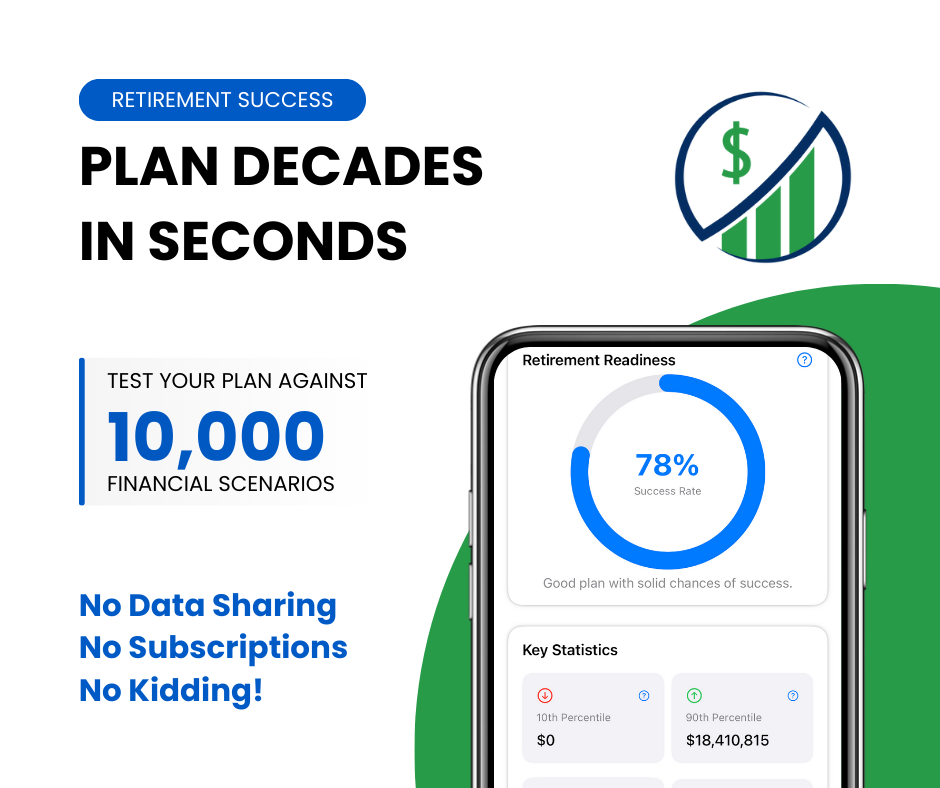
We’ve heard from thousands of FIRE community members, and the message was clear: you wanted deeper tax analysis, realistic account modeling, and Social Security claiming strategies that reflect how retirement finances actually work.
Today, we’re excited to announce a major feature expansion for Retirement Success Graph in version 2.5 that brings institutional-level retirement analysis to your pocket—without subscriptions, data uploads, or hidden fees.
What’s New: Features That Change How You Plan
Free Feature: Tax-Bracket Support
Every user now has access to tax-bracket modeling that accounts for how your retirement income actually flows through the federal tax system. This isn’t a simple percentage calculation—it’s bracket-aware analysis that recognizes the marginal nature of tax rates.
Why does this matter? According to the IRS, retirement withdrawals from traditional 401(k) and IRA accounts are taxed as ordinary income. A flat “effective tax rate” assumption—common in most retirement calculators—can dramatically overstate or understate your actual tax burden depending on where your income falls across brackets.
With tax-bracket support, your Monte Carlo simulations now reflect the reality that your first $11,600 of income (single filer, 2024) is taxed at 10%, the next portion at 12%, and so on. This granular modeling produces more accurate success rates, especially for early retirees managing income strategically before RMDs begin.
Premium Feature: Expanded Account Type Support
Premium users now have access to comprehensive savings models supporting:
- Traditional IRA – Tax-deferred growth with RMDs starting at age 73
- Roth IRA – Tax-free growth with no lifetime RMDs for the original owner
- Traditional 401(k) – Employer-sponsored tax-deferred savings
- Roth 401(k) – Post-tax contributions with tax-free qualified withdrawals
- Post-tax (taxable) brokerage accounts – Flexible access with capital gains considerations
This expansion addresses one of the most requested features from the FIRE community. Real retirement portfolios aren’t single buckets—they’re strategic combinations of accounts with different tax treatments, access rules, and planning implications.
The IRS confirms that RMD rules apply differently across account types: traditional IRAs and 401(k)s require minimum distributions starting at age 73, while Roth IRAs have no RMD requirement during the owner’s lifetime. These distinctions significantly affect withdrawal sequencing, tax planning, and portfolio longevity—all of which are now modeled in your simulations.
Premium Feature: Required Minimum Distribution (RMD) Modeling
Starting at age 73, the IRS requires you to withdraw minimum amounts from tax-deferred retirement accounts each year. Miss an RMD, and you face a 25% excise tax on the amount not distributed (reduced from the previous 50% penalty under SECURE 2.0).
Our new RMD modeling automatically calculates these mandatory withdrawals based on IRS life expectancy tables and projects their impact across thousands of Monte Carlo scenarios. This is critical for:
- FIRE planners bridging to traditional retirement – Understanding when RMDs will force taxable income
- Roth conversion strategists – Seeing how converting before RMDs affect long-term outcomes
- Couples with different account balances – Modeling household-level RMD obligations
The simulation engine accounts for the SECURE 2.0 changes that eliminated RMD requirements for Roth 401(k) accounts, ensuring your projections reflect current law.
Premium Feature: Social Security Spouse Benefit Claiming Options
Social Security claiming strategy is one of the highest-stakes decisions in retirement planning. For married couples, it gets even more complex.
Spousal benefits allow a lower-earning spouse to claim up to 50% of the higher-earning spouse’s benefit at full retirement age—but only after the working spouse has filed. According to Vanguard’s research on Social Security strategies for married couples, optimizing these decisions can add tens of thousands of dollars to lifetime household income.
Retirement Success Graph now models:
- Coordinated claiming ages for both spouses
- Spousal benefit calculations based on each partner’s primary insurance amount
- Survivor benefit implications – The higher earner’s delayed credits increase the survivor benefit
The Social Security Administration notes that spousal benefits don’t grow beyond full retirement age, making optimal timing crucial. Our Monte Carlo simulations test these claiming decisions against thousands of market scenarios to show how different strategies affect your overall success probability.
Why These Features Matter for the FIRE Community
The FIRE movement has always been about taking control of your financial future. But most retirement calculators were built for traditional retirees—people who work until 65, collect a pension, and draw Social Security immediately.
Early retirees face different challenges:
- Longer time horizons – A 40-year retirement amplifies sequence-of-returns risk
- Healthcare bridge gaps – The years between early retirement and Medicare
- Tax optimization windows – Roth conversions and strategic withdrawals before RMDs
- Social Security timing flexibility – More options when you’re not forced to claim immediately
These new features address the complexity that generic calculators miss. When you model a 45-year-old retiring with a mix of traditional and Roth accounts, planning to claim Social Security at different ages than their spouse, with RMDs eventually forcing distributions—you need tools that can handle that reality.
The Privacy Advantage Remains
Every calculation still happens on your device. We don’t upload your financial data to servers. There’s no account creation, no login, and no subscription.
This isn’t just a privacy feature—it’s a trust feature. Financial planning software handles some of the most sensitive projections you’ll ever make. Your retirement readiness shouldn’t be monetized as data.
What Comes Next
We’re continuing to develop features based on community feedback:
- Enhanced withdrawal sequencing – Automatic suggestions for which accounts to tap first
- Tax-loss harvesting modeling – For taxable accounts in down markets
- Medicare premium integration – IRMAA surcharge projections based on income
Your input shapes our roadmap. Use the feedback option in the app settings to tell us what analysis capabilities would help your planning.
Try the New Features Today
The tax-bracket support is available immediately for all users. Premium features—including expanded account types, RMD modeling, and Social Security spouse benefits—are included in the one-time $4.99 upgrade.
No subscriptions. No ongoing fees. Just professional-grade retirement analysis that respects your privacy.
Download Retirement Success Graph and stress-test your retirement plan against 10,000 market scenarios. Your future self will thank you.
Retirement Success Graph uses Monte Carlo simulation—the same methodology used by professional financial planners—to test your retirement plan against thousands of possible market conditions. Results are for educational purposes only and should not be considered financial advice. Consult a qualified financial professional for personalized guidance.
Sources:
- IRS. “Retirement Plan and IRA Required Minimum Distributions FAQs.” https://www.irs.gov/retirement-plans/retirement-plan-and-ira-required-minimum-distributions-faqs
- IRS. “Required Minimum Distributions (RMDs).” https://www.irs.gov/retirement-plans/plan-participant-employee/retirement-topics-required-minimum-distributions-rmds
- Social Security Administration. “Benefits Planner: Retirement | Filing Rules for Retirement and Spouses Benefits.” https://www.ssa.gov/benefits/retirement/planner/claiming.html
- Social Security Administration. “Benefits for Spouses.” https://www.ssa.gov/oact/quickcalc/spouse.html
- Vanguard. “Social Security Strategies for Married Couples.” https://investor.vanguard.com/investor-resources-education/social-security/strategies-for-married-couples
- Fidelity. “Roth IRA Contribution and Income Limits for 2025 and 2026.” https://www.fidelity.com/learning-center/smart-money/roth-ira-contribution-limits