
Perhaps like many of you reading this, I always wanted to retire early, but for quite some time I didn’t know *how* to achieve it. Thankfully, a lot of people do know how and are willing to share their insights on a great Reddit community known as r/FIRE.
WHAT IS FIRE?
FIRE is an acronym for “Financial Independence, Retire Early.” While there are various thoughts on how the acronym became more common, the concept was popularized in the book “Your Money or Your Life” by Joe Dominguez and Vicki Robin, which characterized the choices behind trading time for money, and updated more recently by the 2010 book Early Retirement Extreme, which advocated downsizing lifestyles as a method to boost savings.
While not everyone in the r/fire community is planning to retire early, the vast majority of the active users are pursuing a financial plan to give themselves the independence to choose their financial future – whether or not that includes retiring! For me, FIRE meant getting to the point where we stopped trading time away from family and interests for money. Reaching that threshold (whatever it may be for you) opens a door filled with incredible choices.
HOW FIRE WORKS
The core tenets behind FIRE are devising a realistic spending plan for your retirement years, spending conservatively, and making sound yet aggressive investments. The community believes strongly in the Rule of 25 (a.k.a. The 4% Rule), meaning that financial independence occurs when you have twenty-five times your annual spending. This makes developing the plan critically important, as it is truly the roadmap for your financial independence.
For example, if your plan is to fund $75,000 in expenses, the Rule of 25 would dictate that you should have savings of at least $1,875,000. For many, this level of precision can be intimidating. To simplify, multiply your current monthly budget by 12 months, and that total by 25. This is your FIRE Number and a good place to start focusing your financial plan in today’s dollars. Additional factors, including inflation, market returns, and one-time expenses, must also be considered.
The 4% Rule governs withdrawals in retirement. Under normal circumstances, FIRE advocates explain that withdrawing 4% of your savings means that your nest egg should last 25 years. In the example above, a retiree with $1,875,000 in savings would spend $75,000 or 4% (a.k.a. The 4% Rule / The Rule of 25). In good times, investment choices should allow you to earn more than a 4% annual return, meaning that you can make annual withdrawals without touching your original savings. In lower markets, you may still withdraw 4% (of a potentially smaller nest egg) or flex your withdrawal percentage downward to 3%, for example.
FIRE is (understandably) a very appealing and popular investment philosophy, and there have been a few “spin-offs” from the FIRE movement.
- Fat FIRE: For those with higher-paying traditional jobs, Fat FIRE means taking a high salary but saving substantially more than average. This strategy allows you to “buy years” by investing more than one year’s worth of savings at a time. For example, rather than saving 15% of your salary, saving 30% would be the equivalent of saving for two years at once. If you’re able to make the higher savings rate work, FatFIRE (combined with aggressive investment) can cut the number of years worked towards retirement in half.
- Lean FIRE: For those with more day-to-day flexibility, this strategy outlines living far below your means to allocate more earnings towards aggressive investing. In some instances, upper-middle-class executives following Lean FIRE may choose to reduce their lifestyle by one-half or more than their peers. While this technique varies, the concept is “paying yourself first” so that you can have a more luxurious life in your “retirement” years.
- Barista FIRE: For those looking to leave a traditional workforce job as soon as possible, Barista FIRE advocates trade full-time work for reduced hours while living very conservatively. While challenging, many believe this is the best of both worlds – providing the immediate benefit of available time.
HOW TO GET STARTED
Financial independence and early retirement are universally popular, but FIRE isn’t for everyone. Before you commit to any steps with your finances, do your own research to understand what FIRE is/isn’t and how it may help you meet your goals. Some of the best resources include Reddit’s r/fire community and independent sources.
Like all investment strategies, the most essential part of FIRE is creating a financial plan that reflects your unique goals and priorities. Whether you want to live lavishly or pursue a no-frills life, everyone’s situation is different, and FIRE only works when you have an accurate estimate of your goal.
As you begin saving, create an Emergency Fund to help with unexpected expenses. Separate from your general savings rather than a pool of money you can access immediately for unexpected bills, such as healthcare or loss of employment. Experts differ on how much to save, but the consensus opinion is that having months of expenses saved is key.
It’s also a wise idea to consult a Certified Financial Planner. A Certified Financial Planner (CFP) is a financial professional who has met education, examination, experience, and ethical standards to provide comprehensive financial planning advice. The certification is granted by the Certified Financial Planner Board of Standards (CFP Board). Unlike the general term “financial advisor,” the CFP designation indicates a high level of expertise and a commitment to acting as a fiduciary, which means putting the client’s interests first.
Most importantly, keep in mind that FIRE is a how, not a what. The ultimate goal is a happy life. If FIRE can help you get there, great!
TESTING YOUR PLAN
As discussed, having a financial plan is key. Certified financial planners can help you stress test your plan to ensure that it will hold up in both good and bad economic conditions. Recessions, depressions, pandemics, stock market booms, revolutionary technologies, and international relations all play a role in financial outcomes. CFPs utilize a modeling tool known as Monte Carlo Simulation.
Developed by John von Neumann and Stanislaw Ulam in the 1940s, Monte Carlo models utilize statistics and math to predict the outcome of unknown future events. Known as a “probabilistic model”, Monte Carlo scenarios can include an element of uncertainty or randomness in their predictions. The models will return different results every time, but – when taken on a large scale – they can determine the probability of specific outcomes.
For example, the distance between your home and office doesn’t change, but your commute can vary based on traffic, weather, accidents, errands, or breakdowns. You could use a Monte Carlo model to simulate 1,000 trips to and from work. The results would show you a consistent median travel time, but also high and low probabilities.
For your investment plan, Monte Carlo tests will factor in decades of economic variables to test your investment plan. The Retirement Success Graph app runs up to 10,000 different variations to determine if your investment plan is likely to meet your financial goals. By continually changing the variables of investment returns, inflation, expense variations, market variables, and many more, the app can provide a high level of statistical accuracy for your retirement plan and help guide you on your path to Financial Independence and Retiring Early.
FROM CHAOS TO CLARITY
RETIREMENT SUCCESS GRAPH APP
Retirement Success Graph represents a paradigm shift for the FIRE community, delivering institutional-grade Monte Carlo analysis directly to your smartphone without compromising your financial privacy. Unlike generic retirement calculators that rely on simplistic linear projections, this app harnesses the statistical power of up to 10,000 Monte Carlo simulations to stress-test your early retirement strategy against decades of potential market volatility, inflation scenarios, and sequence-of-returns risk. For FIRE practitioners targeting retirement between ages 40-65, this level of analytical rigor is essential—the difference between confidently pulling the trigger on early retirement versus gambling with your financial future. The app’s sophisticated modeling includes advanced withdrawal strategies beyond the basic 4% rule, Social Security optimization across multiple claiming scenarios, and dynamic portfolio management approaches that adapt to changing market conditions.
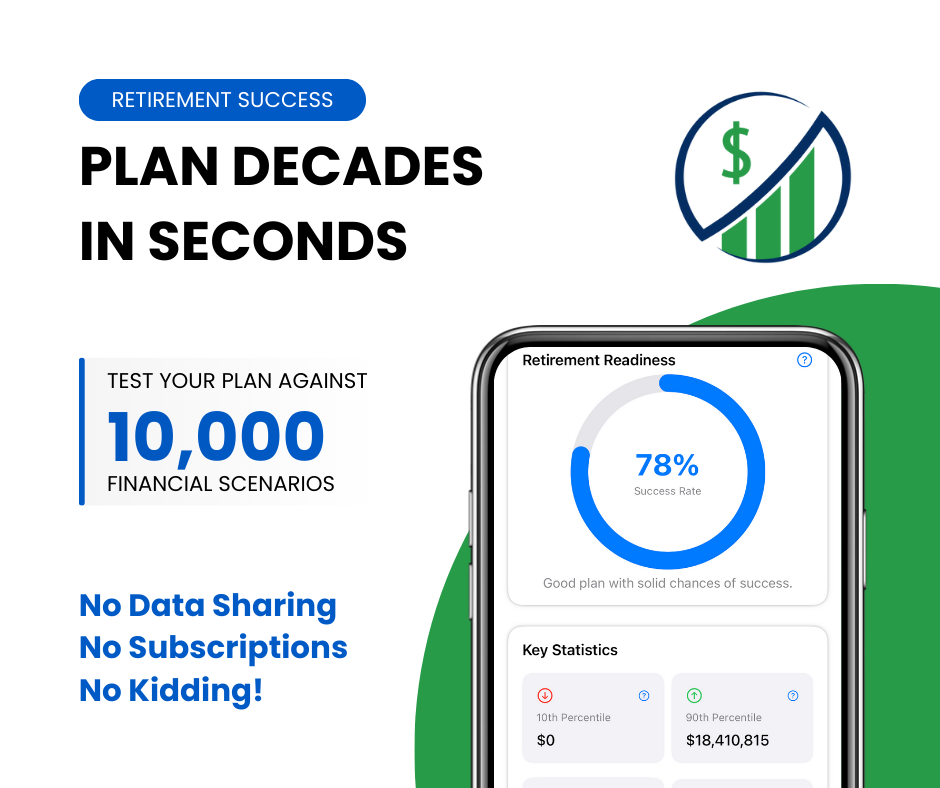
What sets Retirement Success Graph apart in an increasingly surveillance-heavy digital landscape is its unwavering commitment to financial privacy—a critical concern for high-net-worth individuals planning early retirement. The app requires zero registration, stores no personal data in the cloud, and performs all calculations locally on your device, ensuring your retirement projections, asset values, and financial strategies remain completely private. This on-device processing approach means you can model sensitive scenarios, test aggressive FIRE timelines, and optimize withdrawal strategies without creating a digital footprint that could be accessed by data brokers, financial institutions, or government agencies. For serious FIRE candidates who understand that financial independence requires both mathematical precision and operational security, Retirement Success Graph delivers professional-grade analysis with consumer-level privacy protection—making it an indispensable tool for anyone committed to achieving early retirement with confidence rather than hope.
Ready to get started? Download the Retirement Success Graph app on the Apple App Store for iPhone and iPad.